From Midea PortaSplit's Explosive Sales to the Reshaping of European Cooling Trade Opportunities
In the summer of 2026, severe heatwaves are fundamentally shifting European household consumption habits. A relentless heat wave across France, Germany, the UK, and Spain has triggered a sudden surge in cooling equipment procurement across a region historically known for low air-conditioning penetration.
Air conditioners were rarely considered home necessities by European consumers in the past. However, with extreme heat becoming more frequent, the European market is pivoting rapidly—and Chinese manufacturers have emerged as the biggest beneficiaries of this demand shift. According to the latest trade data, in the first half of 2026, China's air conditioner exports to the EU reached $3.76 billion, up 43.2% year-on-year, setting a new historic record for the period. Imports into France, the Netherlands, and Belgium grew significantly, while exports of portable and installation-free air conditioners registered a growth rate exceeding 70%.
Why Are European Consumers Rush-Buying a "Made-in-China" Air Conditioner?
One of the most talked-about products in the European market this year is the PortaSplit Mobile Split Air Conditioner, launched by Chinese giant Midea. Unlike traditional European AC installations, the PortaSplit was engineered specifically for Europe's unique living conditions:
No alteration to exterior walls
No professional installation required
Rental-friendly design
Adaptable to traditional European window frames
This design directly addresses the structural barriers that have long hindered AC adoption in Europe.
Historically, the European air conditioning market faced several pain points:
Exorbitant Installation Costs: A standard split-system unit might cost €600–€800, but professional installation fees often exceed €1,000—making labor more expensive than the unit itself.
Protracted Wait Times: During peak summer months, licensed HVAC installers are severely overbooked, forcing consumers to wait several weeks.
Architectural Restrictions: Historic districts in cities such as Paris and Vienna strictly prohibit modifications to the facades of historic buildings.
Large Rental Market: A high percentage of European residents live in rental properties and are unwilling to invest in permanent, high-cost installations.
Under these exact constraints, "installation-free" air conditioning became the breakthrough market segment.
Midea PortaSplit Sales Surpass 200,000 Units as Chinese Brands Capture New European Demand
Data disclosed by Midea's European division indicates that sales of the PortaSplit in Europe have already surpassed 200,000 units this year—nearly doubling year-on-year.
The product has reportedly faced supply shortages across key markets, including Germany, France, the Netherlands, and the UK.
Meanwhile, Midea reported that its overall AC sales across major Western European markets (Germany, France, Spain, and the UK) grew by over 70% year-on-year in the first half of 2026.
This success extends beyond a single product—it signals a structural transition in the European cooling market:
The Past: Fixed Split AC + Professional Installation Service
The Present: Plug-and-Play + Flexible Mobility + Zero/Low Installation Cost
This shift opens a fresh export window for Chinese HVAC manufacturers.
Customs Data Reveals: Europe Emerges as China's New AC Export Growth Engine
Trade statistics confirm that China's air-conditioning sector is entering a new export expansion cycle.
According to public trade data for H1 2026:
China's AC Exports to the EU: $3.76 Billion
Year-on-Year Growth: +43.2%
Market Highlights: Rapid import expansion in France, the Netherlands, and Belgium, alongside double-digit growth in Spain and Germany.
For international trade enterprises, this means the European AC market is no longer a generic home appliance arena—it is forming lucrative new niche opportunities.
What Trade Opportunities Are Emerging from Customs Data?
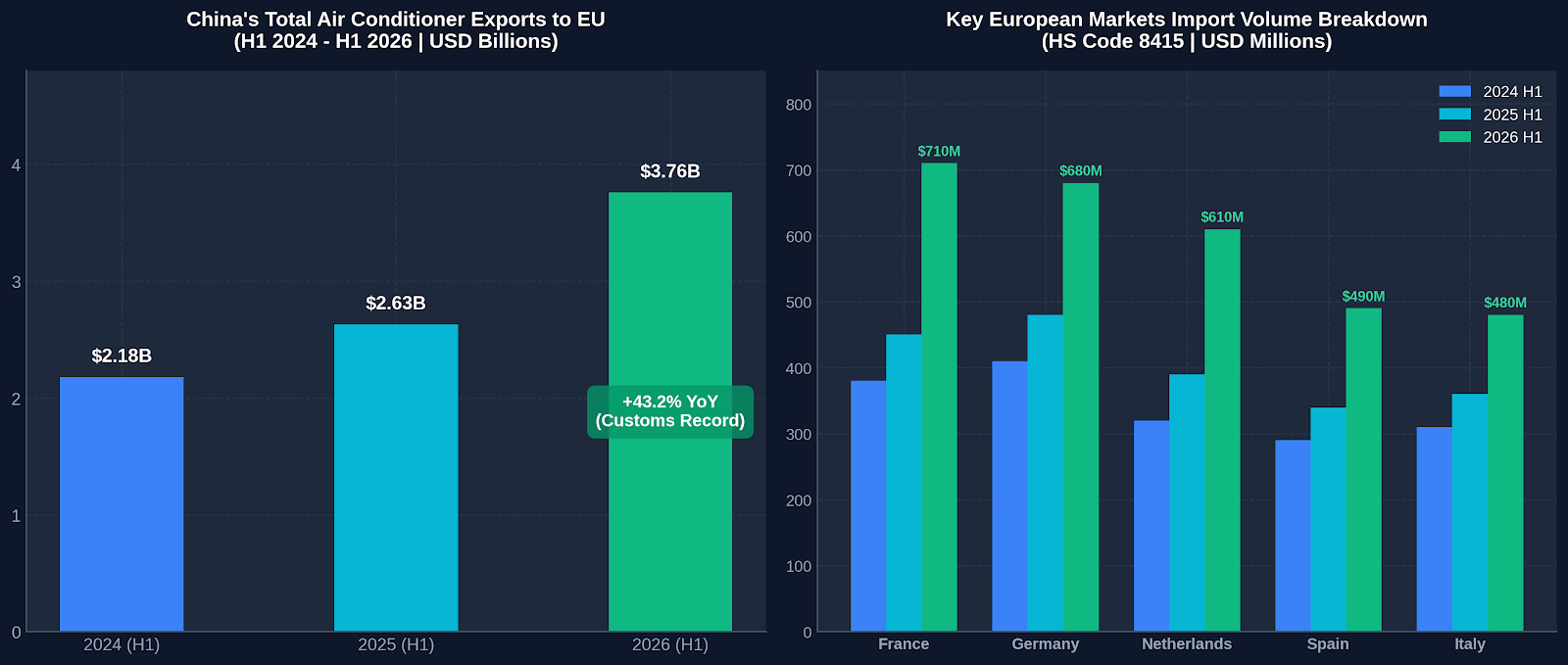
Using HS Code 841510 (Window or wall air conditioning systems, self-contained or "split-system") as an analytical entry point, traders can track several emerging opportunities:
Opportunity 1: Identifying New European Importers
High-growth markets invariably lead to supply chain realignments.
Focus markets include:
France
Germany
The Netherlands
Spain
United Kingdom
Customs data allows businesses to analyze:
Importers scaling up procurement volumes;
European buyers adding new Chinese suppliers;
Distributors actively expanding inventory.
Example: If a European appliance distributor historically imported a few hundred units annually and suddenly scales to several thousand, it typically indicates channel expansion, rising local demand, or an active search for new manufacturing partners in China.
Opportunity 2: Capitalizing on the "Installation-Free Cooling" Category
Beyond traditional units, European demand is broadening into adjacent product lines:
Portable Air Conditioners
Mobile Split ACs
Air Coolers / Evaporative Coolers
Dehumidifiers
Heat Pump Systems
These products align seamlessly with evolving European consumer preferences: no structural building changes, lower energy consumption, tenant friendliness, and zero installation friction.
Opportunity 3: China's Supply Chain Upgrade: From "Manufacturing Export" to "Demand-Driven Export"
Historically, Chinese exporters relied primarily on price competitiveness and volume manufacturing capacity.
However, the PortaSplit case demonstrates a strategic pivot: Deep Market Insight → R&D Collaboration → Localized Design → Global Distribution.
The product underwent over three years of development, driven by localized requirements identified by European teams and co-developed alongside China-based R&D teams. Future export success will depend less on simply finding buyers and more on diagnosing market pain points early.
Strategic Takeaways for Foreign Trade Enterprises
The heatwave-driven surge in European AC sales is not a fleeting seasonal anomaly. It is the structural outcome of long-term climate change, low regional AC penetration, and China's nimble manufacturing innovation coming together.
For HVAC, appliance, and cooling equipment exporters, key operational focus areas should include:
Monitoring European countries exhibiting sustained import growth;
Tracking new procurement entrants and rising buyers;
Observing shifts in legacy supplier partnerships;
Prioritizing portable, energy-efficient product lines;
Supporting distributor channel expansion.
By leveraging customs data, trade businesses can stay ahead of the market—identifying who is buying more, who is sourcing new suppliers, and which markets are accelerating fastest.
Data doesn't predict the weather, but trade statistics reveal demand shifts long before they hit the mainstream.