China Auto Parts Exports 2026: Market Layout, Product Mix, Risks & Untapped Opportunities
China has consolidated its position as one of the world’s largest auto parts exporters. Driven by complete vehicle overseas shipments, mature manufacturing clusters, and competitive cost performance, auto parts exports maintain steady growth amid global supply chain restructuring.
This report analyzes China’s auto parts export landscape from market distribution, hot-selling product categories, competitive strengths, major risks, emerging blue ocean markets, and practical business suggestions. It helps overseas importers, wholesalers, and repair chain operators understand sourcing patterns, while supporting Chinese exporters to identify high-potential target regions.
China’s auto parts exports continue to expand steadily. Mature aftermarket replacement parts remain the core export volume driver, while NEV (New Energy Vehicle) components deliver fast-growing new export momentum. Mature aftermarket spare parts (brakes, filters, chassis, body components) occupy the largest export proportion. NEV spare parts, including battery-related assemblies, thermal management parts, and electric drive components, record remarkable year-over-year growth. Trade pattern evolves: “Deep cultivation in traditional large markets + breakthrough in emerging regional markets” becomes the mainstream strategy for Chinese component factories.
1. Key Export Destination Markets
North America is dominated mainly by the United States; Southeast Asia and Africa show the fastest year-on-year increase.
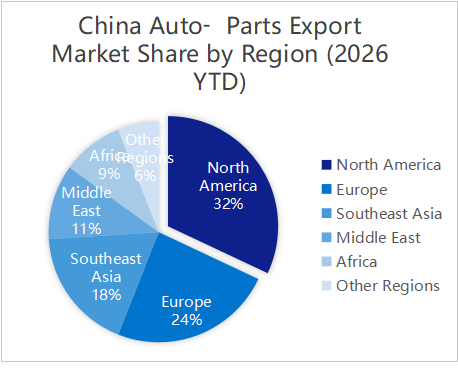
Core Mature Markets
United States: The No.1 single-country destination for Chinese auto parts imports. A large ageing vehicle fleet creates huge aftermarket replacement demand. However, exporters face continuous tariff pressure and trade policy uncertainty.
European Union (Germany, UK, France): High requirements for product certification, quality standards and after-sales service. Braking discs, control arms, filters and lighting parts enjoy strong demand. Each EU member enforces separate compliance rules.
Japan & South Korea: Mainly import replacement mechanical parts, rubber components and body accessories, with high requirements on product consistency.
High growth Emerging Markets (Blue ocean Focus)
Southeast Asia (Malaysia, Vietnam, Thailand): Fast-growing vehicle parc; strong demand for aftermarket repair parts. Many goods serve as transit cargo for further re-export. PVOC, CO and other local certification requirements must be observed.
East Africa (Tanzania, Kenya, Uganda): Local manufacturing capacity is extremely limited; over 90% of auto spare parts rely on imports. A large second-hand right-hand-drive vehicle stock generates massive replacement part demand.
Middle East (Saudi Arabia, UAE): High demand for heavy-duty truck parts, air conditioning components, and wear-resistant spare parts under harsh desert road conditions.
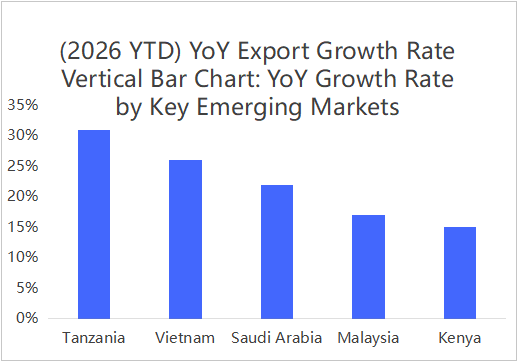
2. YoY Growth Rate by Key Emerging Markets (2026 YTD)
Tanzania ranks first among the listed markets, benefiting from low domestic production and re-export demand towards inland East African countries.
3. Product Structure of China Auto Parts Exports
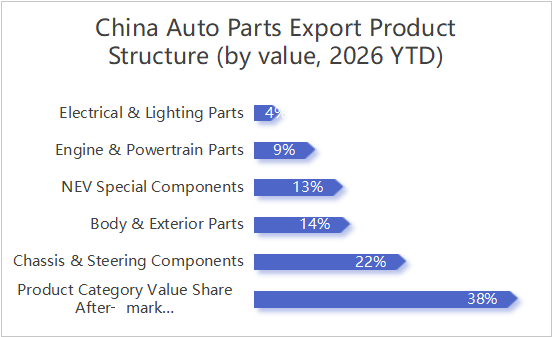
Traditional aftermarket consumable parts still hold the largest share; NEV components maintain rapid incremental growth.
Major selling category details:
Wear and tear aftermarket parts: Brake pads, oil filters, air filters, shock absorbers. Universal replacement parts with huge repeat order demand across global markets.
Chassis & steering parts: Control arms, steering assemblies, leaf springs, widely in demand for heavy-duty trucks in Africa and the Middle East.
NEV-specific components: Battery housings, cooling modules, electric motor accessories; a primary growth driver for exports to developed markets.
Body & exterior parts: Bumpers, lamp assemblies, mirror assemblies, subject to strict local regulatory certification standards.
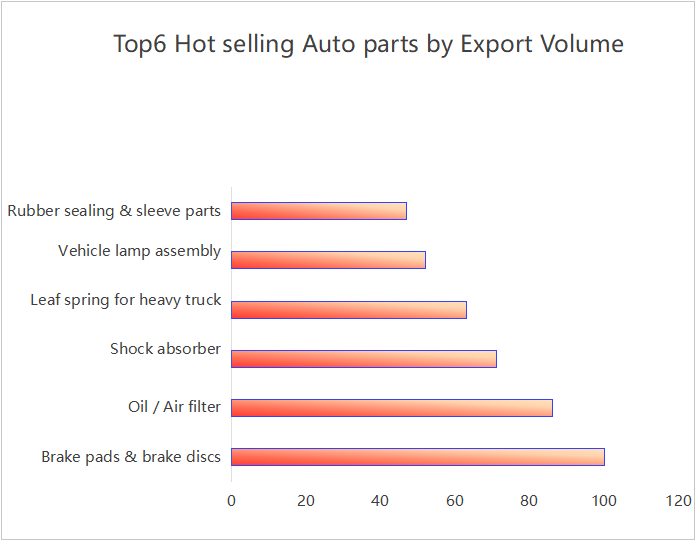
4. Top 6 Hot-selling Auto Parts by Export Volume
5. Competitive Advantages for Chinese Auto Parts Suppliers
Complete industrial cluster: Mature supply chains in Zhejiang, Jiangsu, Shandong, and Guangdong support one-stop sourcing for thousands of spare part SKUs.
Strong cost performance: Price advantage over European and American brands, with a good balance between quality and cost; well accepted by aftermarket wholesalers in emerging economies.
Flexible production capacity: Supports both large batch OEM orders and small batch aftermarket replacement orders.
Fast-rising NEV supporting capability: China has accumulated full set manufacturing experience for new energy vehicle components, opening a new export track.
Major Risks & Challenges
Trade barriers & tariff pressure: Additional U.S. tariffs and anti-dumping investigations in some regions raise export costs.
Mandatory local certification: PVOC (East Africa), E mark (EU), SABER (Saudi Arabia) are compulsory. Missing certificates may result in customs detention or return/shipment of goods.
Intense price competition: Suppliers from India and Turkey compete fiercely across African and Middle East markets. Pure low-price strategies lead to thinner profit margins.
Quality inconsistency risk: Varying quality levels among Chinese manufacturers may harm the overall market reputation of Chinese-origin auto parts.
6. Strategic Recommendations for Exporters
Segment markets by product positioning: Sell high-margin NEV & precision parts to Europe and North America; supply cost-effective wear and tear spare parts to Africa, Southeast Asia and the Middle East.
Prioritize compliance certification: Complete mandatory certifications for target markets before mass shipment to avoid customs related risks.
Utilize trade data to screen buyers: Analyze import volume, purchase frequency and supplier preferences via customs data to locate high-quality, stable importers.
Diversify market layout: Reduce overreliance on any single large market; explore blue ocean markets such as Tanzania and neighbouring East African nations.
Explore import trends, buyer lists, and HS code trade statistics for auto spare parts directly on our platform.